


.png)
Celebrating Juneteenth during the USA vs Australia Match in Seattle
Written by Angelica Heimbigner
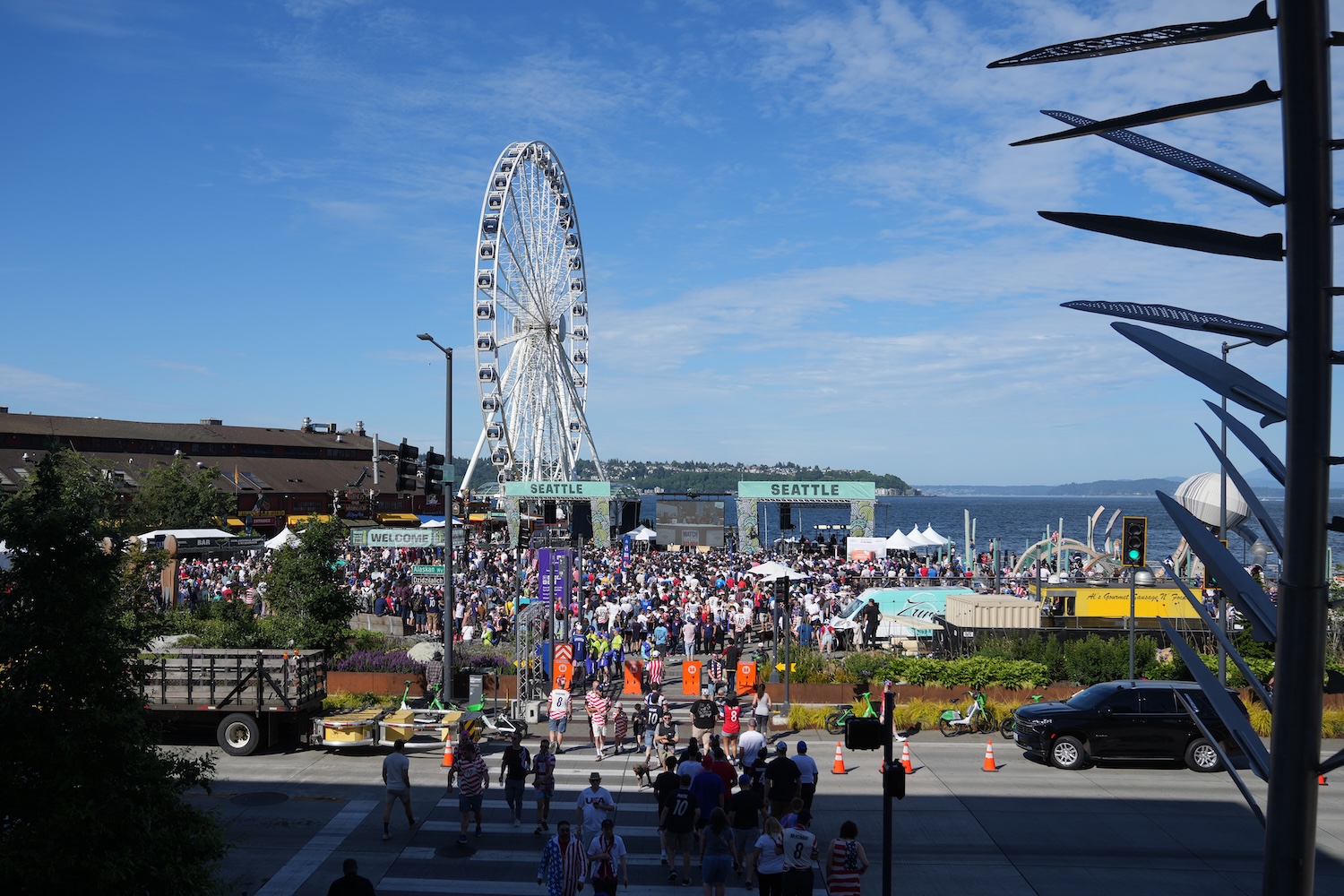
While the stage for the World Cup was being set in Seattle, it was widely understood that the US Men's National Team's match against Australia on June 19 would sell out. Efforts to organize activities and experiences for non-ticketed fans, along with their safety, were a priority in the planning process. One of these activities was the "March to the Match", which began at Pier 58 and exceeded the expectations of just how many people would be in attendance, reaching a total of roughly 15 thousand fans marching together.
"It was a special moment. With how everything lined up, it was a privilege to be a host city to the home team on such a beautiful day, [to] win, and help make such a once-in-a-lifetime experience for folks," Dylan Ordoñez, SVP of External Affairs for the Seattle FIFA World Cup 26™ Local Organizing Committee, said.
In Seattle Stadium's surrounding area, the streets were full of rowdy fans taking part in watch parties and celebrating with the rest of the city, a buzzy environment encouraged and prepared for by the LOC and local businesses. From Seattle Center to Pacific Place to the Waterfront, every block of the downtown area was ignited with the energy of fans excited to cheer on their country, whether it was the US or Australia. With such a busy setting and bustling crowds from the match and watch parties, small businesses nearby were provided with the chance to go where the people are and draw in fans as a way to not only support the community but also to advocate for their businesses.
The atmosphere created by fans inside the stadium, full of red, white, and blue, right before the game was "pure excitement and anticipation," Ordoñez said. "After the match, there was spontaneous singing. The whole stadium was singing ["Take Me Home, Country Roads" by John Denver] together, which was special, and then there was also spontaneous singing of the national anthem as people were exiting the stadium. I was working most of the match, getting in my steps, and moving people around, but everyone was so excited. That is really what it was; that unity is really special."
Hosting a World Cup match on Juneteenth in Seattle, especially with such massive crowds and millions of viewers the USMNT brought with them, created a special opportunity for the LOC to bring about awareness and educate people about the significance of the date in history, as well as spotlight local Black organizations and businesses.
Two days before the match, a press conference highlighting Juneteenth was held at the Seattle International Media Center. The conference featured civic leaders and community representatives who spoke about their experiences and the importance of acknowledging and commemorating Juneteenth and African American history on an international stage. Following the press conference, there was an opportunity for people to attend the planned excursion to Seattle's Northwest African American Museum, which premiered an exhibit called "The Story of the Salute" commemorating athletes Tommie Smith, John Carlos, and Peter Norman protesting racial injustice in sport and society at their medal ceremony during the 1968 Mexico City Olympics.
The LOC also partnered with FIFA to showcase a pre-match video on the jumbotrons in the stadium acknowledging Juneteenth and cheering on the national team. Juneteenth designs and art created specifically for the LOC were also displayed in the stadium for people to see and admire. The designs and art that were displayed in the stadium were created by artists Samray Estifanos and Damon Brown.
Wrapping up the games being held at Seattle Stadium, the city has firmly established itself as a world-class event host after exceeding initial predictions of 750 thousand visitors by nearly 500 thousand over the span of all six matches. The time, dedication, resources, and people that went into making the World Cup games, accompanied by many watch parties and fan experiences, turned Seattle into a soccer powerhouse this summer.
Hosting an international sports tournament has sparked conversation regarding how future sports and fan events in Seattle may be influenced. Seattle can likely expect more opportunities to carry some of these fan celebrations forward, such as having events playing on the large screens at Pacific Place just as they were for each of the six games or implementing the pedestrian zones, which were not only done for the World Cup matches, but for the Seahawks parade earlier this year as well. This experience also allowed small local businesses and sports bars the opportunity to adapt and learn what works well for them and for attracting people to build community and fellowship in the area. Even Seattle's transit system expanded and adapted as well, scheduling more frequent shuttles and extending evening service on match days for the fan crowds.
"I hope this experience shows not only fans but community leaders and government leaders of what is possible when we plan and work together, and what kind of environment we can have and be known for here as a city," said Ordoñez. "It shows that when we want to create an environment where fans can be out in full force and get excited and rally and go to the game, we can do it. I am excited to see exactly how, from all the different lessons learned, fan experiences change. For folks who do not live in Seattle and rode transit in, I hope it shows them what an easy experience it can be to get here."
Dylan Ordoñez's most memorable fan experience from the match was the SeattleFWC26 LOC's youth access initiative, where they were able to send youth and caregivers from across the region to the World Cup matches that were hosted by Seattle. In total, including those who were able to attend the other five matches, the program allocated tickets to 40 non-profits for 14 hundred youth and chaperones and allowed them the life-changing experience of coming to a World Cup game for free.
"I got to be the person to call the nonprofits to tell them; I got to be Santa Claus. Many of them were like, ‘Is this a joke? Is this real? Who are you?’ People were crying; people were just so incredibly touched about this program. I have had a lot of emails, text messages, pictures, testimonials, and anecdotes just saying how impactful this will be for the kids for the rest of their lives," he said. "There were many cool things, but that was one of the absolute coolest, and I will remember those phone calls and emails for the rest of my life."

